September 6, 2013
[singlepic id=243 w=320 h=240 float=left]
According to Claude Monet’s step son Jean-Pierre Hoschedé, the painter loved blue flowers.
This beautiful solanum, a plant belonging to the family of tomatoes and potatoes, is covered with simple little blue flowers.
It matches the colors of the kitchen window with its blue squared curtains, a very typical french pattern called vichy fabric.
In late Summer, plants are at the top of their heigth. With a bit of imagination, the flowers of the Giverny garden look like big waves splashing against the walls of the house.
Posted in Monet's flower garden, Monet's House No Comments »
October 5, 2012
[singlepic id=229 w=320 h=240 float=left]Next year, the Easter week-end is the last week-end of March.
The direction of Fondation Claude Monet has thus decided exceptionnally to open the gardens of Giverny on Saturday 30 March at 9.30am.
This will be two days earlier than the normal date.
Read the rest of this entry »
Posted in Giverny, Monet's House 11 Comments »
August 15, 2012
[singlepic id=226 w=320 h=240 float=right]This flower bed graces the pond side in Monet’s water garden at Giverny. The main color is red, ranging from orange to purple. I’ve counted over 20 different kinds of flowers planted together, but there are probably more. Here are a few: New Guinea impatience, common begonia, angel wing begonia, common fuchsia, fuchsia microphylla, abutilon, asclepia, oxalys, sage, tithonia, heuchera, polygonum, sweet William, nicotinia… to quote only those that are flowering right now. This border is a good example of the way Monet liked to combine flowers. The appearant wildness of the garden is the result of a lot of work.
Posted in Flower, Giverny, Water-Garden No Comments »
June 26, 2012
[singlepic id=224 w=320 h=240 float=left]Just an idea of the profusion of roses blooming in June at Giverny!
For a few weeks, Monet’s garden becomes a rose garden.
Rambling, climbing roses climb on dozens of metallic structures, typical for a garden designed in the 19th Century.
Posted in Giverny, Monet's flower garden 7 Comments »
June 7, 2012
[singlepic id=222 w=320 h=240 float=left]After the yellow and orange Iceland poppies, and the enormous red perennial Chinese poppies, it is now time for the lovely pink annual poppies.
Each year, when they pull the dried ones out of the ground, the gardeners scatter the seeds in the flower beds. They grow everywhere, and they turn the garden into a pink fairy for a few days.
The eremurus, also known as fox tails, create an interesting contrast with their vertical shape.
They are topped by the climbing roses, at their best in June.
Posted in Monet's flower garden No Comments »
April 30, 2012
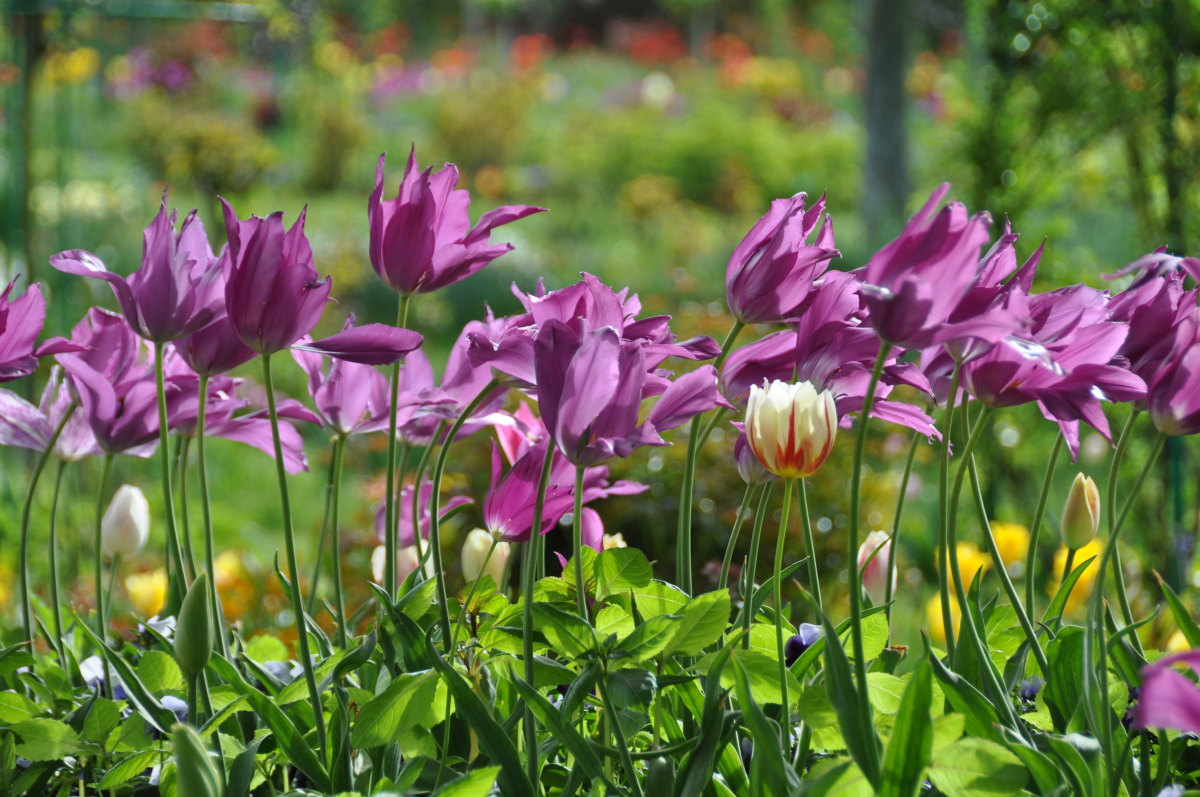
 Tulips spread their colors these weeks at Giverny. It is one of the times of year when the monet garden is at its brightest. The big colorful heads stand side by side, being planted tight, undisturbed by any leaves, that are much lower.
Tulips have the ability of looking thick and massive in direct or mute light, and totally different as soon as the sun shines through their petals. Then, in late afternoon for instance, they become delicate and light, they seem to loose any weight and dance in the breeze.
Posted in Flower, Monet's flower garden No Comments »
April 21, 2012
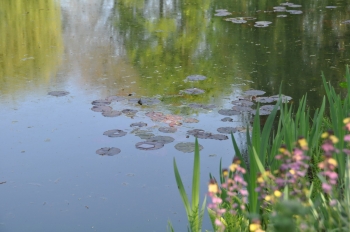 I have eventually gathered my favorite pictures of Giverny into a photo gallery.
Season after season, Monet’s water garden and flower garden change a lot.
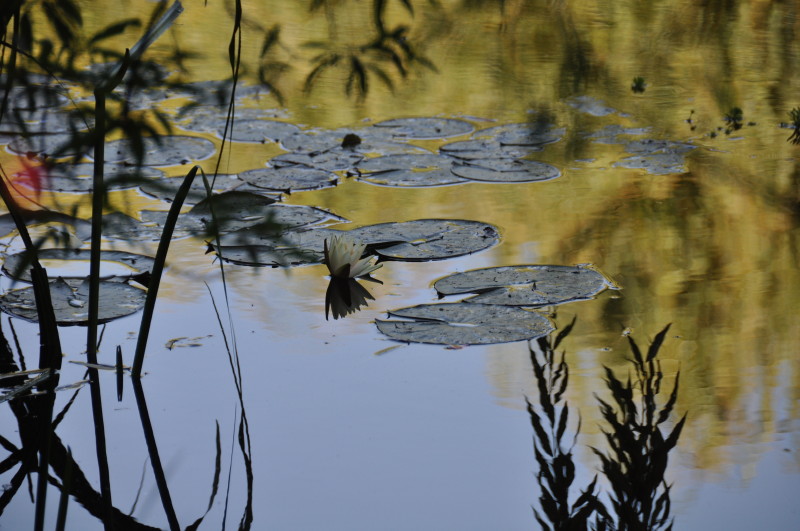
I like early morning atmospheres as well as rainy days, bright sunshine or sunset. I like the snow white garden. I like roses and nympheas. I like the colors of autumn, the stunning reflections on the pond.
I hope you will like them too.
If you’d like painting after my pictures, please feel free. I would be happy to see your work.
Posted in Flower, Monet's flower garden, Water-Garden 6 Comments »
March 23, 2012
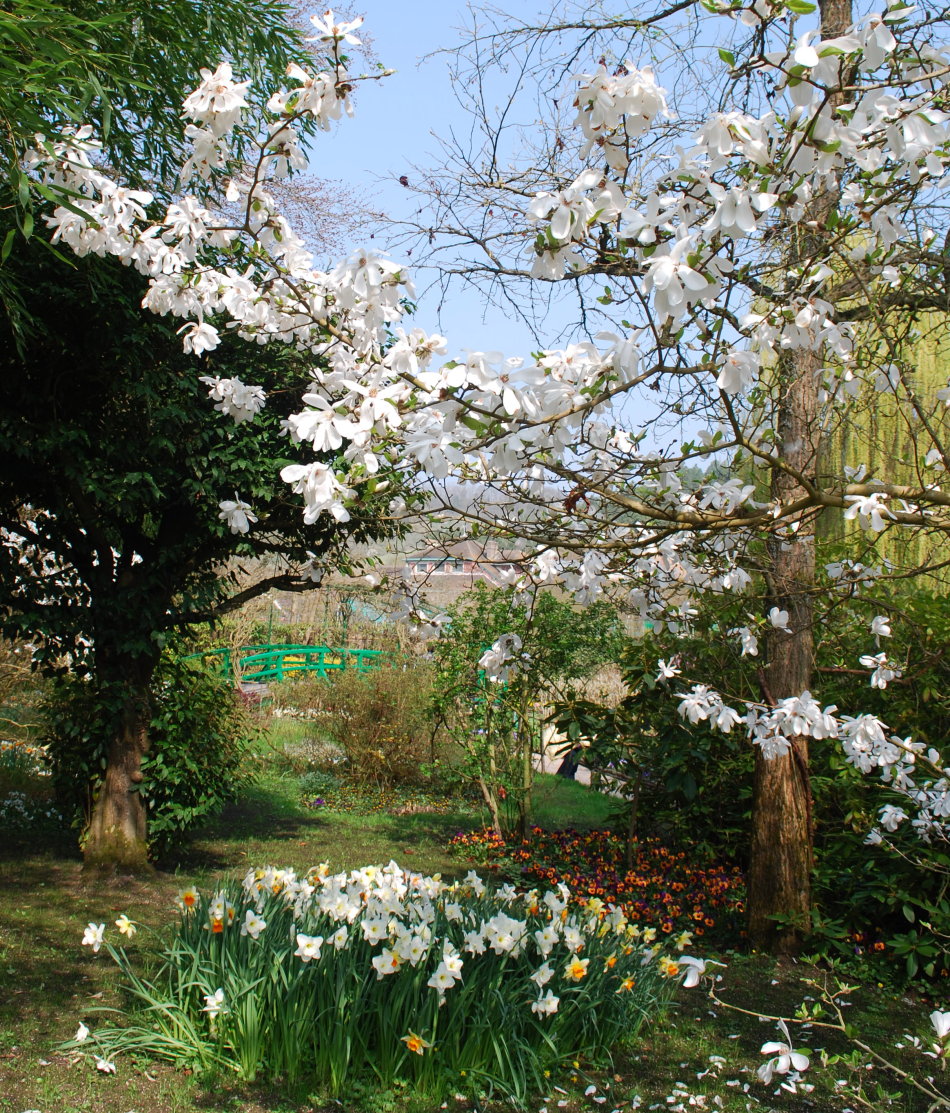
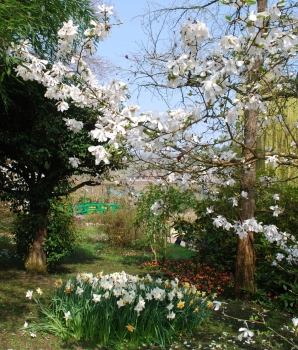 This is what you can expect if you are visiting Giverny in Early April. The white and pink magnolias are in blossom. Very soon, their flowers will fall on the lawns, creating a white circle at the foot of the trees.
The pimples of weeping willows have burst, long branches of fresh green leaves hang over the pond, reflecting in endless verticals.
Patches of yellow or white daffodils illuminate the spring grass and diffuse a fabulous scent.
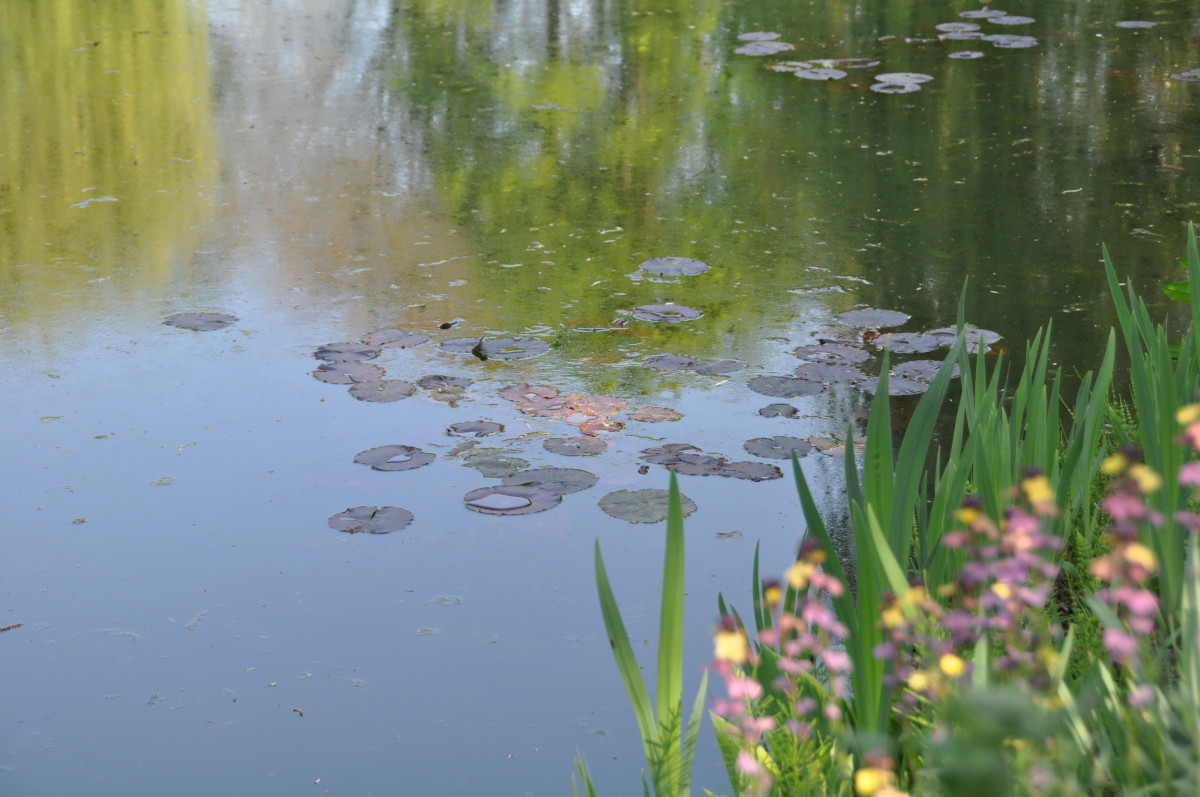
Monet’s pond, where only a few water lily pads announce the future splendour of Summer, is stiller than ever, and the atmosphere very peaceful.
All the benches and bridges have been repainted a bright green. They look inviting.
And birds sing like mads, offering the perfect voice track for a quiet and serene visit of Giverny.
Posted in Monet's flower garden, Water-Garden 2 Comments »
January 15, 2012
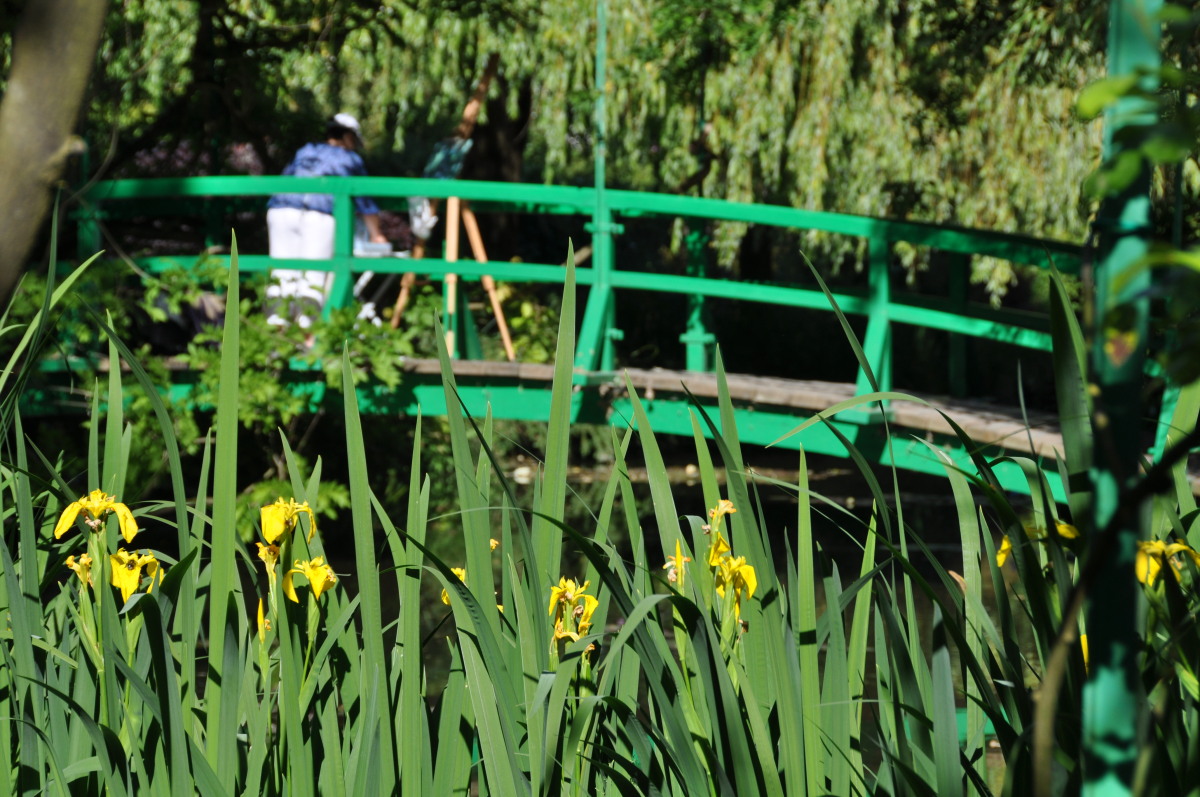
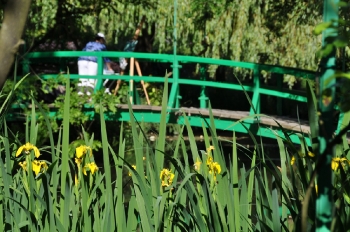 It is many painters’ dream to be able to stay in Monet’s garden to paint.
If your medium is watercolor, pencils, ink… no problem. Just sit down on a bench (preferably) and paint. But if you use acrylic, for instance, and need an easel therefore, you must ask for allowance. Please get in touch with Fondation Monet. If there aren’t too many requests for the day you wish, you will be granted the privilege of staying in the gardens after closing time. This is the best way to feel just like Monet, almost alone on the grounds. Same vibrations, same inspiration. Have a great time!
Posted in Monet's flower garden, Water-Garden 8 Comments »
October 17, 2011
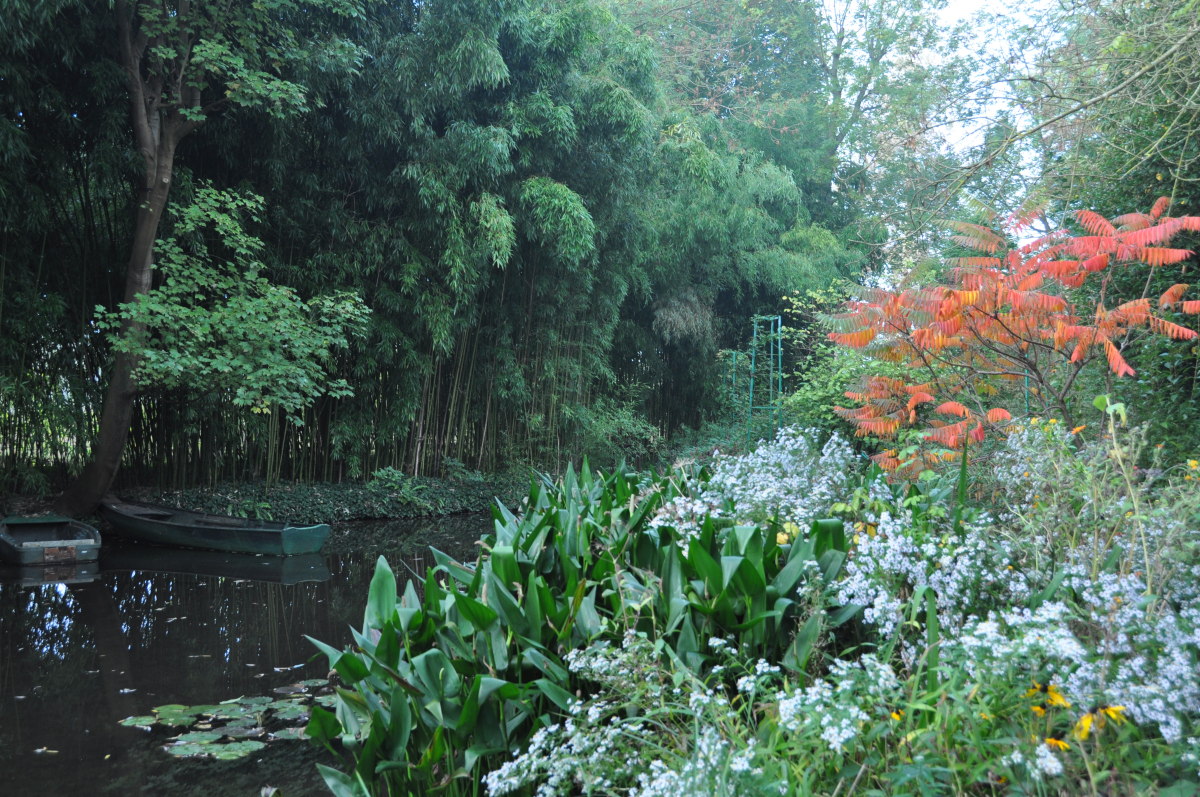
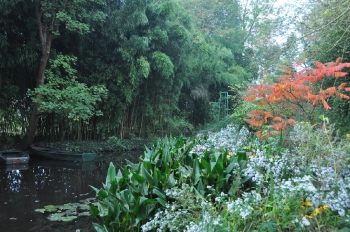 The misty days of October are back! On Monet’s pond at Giverny, they create a soft atmosphere enhancing the different textures of the foliages. Among all these greens, the sumac of Virginia flames. Asters fill in the flower beds in big bouquets. The boat awaits the gardener. He will soon arrive to maintain the pond.
Posted in Giverny, Water-Garden 1 Comment »
September 29, 2011
[singlepic id=187 w=320 h=240 float=right]A look through the window of Monet’s studio, on the ground floor of his house at Giverny.
The garden appears like an additional painting among the canvases hanging on the wall.
Posted in Monet's House No Comments »
July 3, 2011
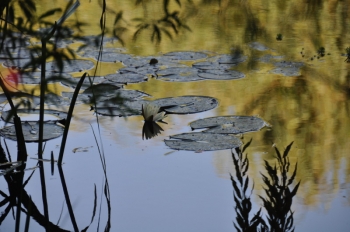 Water lilies are sensitive to cold. When the night is overcast and mild, they are all open in the morning. But if the night is clear, they close and need several hours of sunshine to open again.
They like a warm water not only to open, but also to bloom. On Monet’s pond, water lilies are gorgeous during heat waves, they become scarce during rainy and cool periods.
This is true for a big pond like Giverny. For gardeners who would like to grow water lilies in a wash basin, it is wise to look for a partly shaded spot. In direct sunshine, the water of a small container becomes very warm. If some like it hot, it is not the case of water lilies.
Posted in Flower, Giverny, Water-Garden No Comments »
June 13, 2011
[singlepic id=180 w=350 h=350 float=left]Standard roses are one of the beauties of Giverny.
As tall as trees, they measure over 2 meters and they offer their pink blossom like enormous bouquets.
Rose trees are generally not strong enough to resist wind, so they are grown on metallic structures that look like umbrellas or mushrooms, according to your imagination. Some people call them weeping roses, that’s really too sad.
In Monet’s flower garden, they tower over big bunches of peonies and large flower beds of pink and red poppies.
Posted in Monet's flower garden 4 Comments »
April 15, 2011
[singlepic id=178 w=320 h=240 float=left]In the 19th Century, trees used to be white in Spring. There were white blossoms of cherry trees, white plum trees, white pear trees… Apple trees were slightly tinted with pink when budding, but became white when in bloom. Only southern trees like peach or apricot trees could be pink, however they were rarely to be seen in Normandy.
So we can imagine the novelty of introducing exotic varieties like crab apples, Japanese cherry or plum trees in a little village on the countryside like Giverny. Their pink blossom must have looked unique to Monet, and to his neighbours.
The pink exotic trees are widely spread by now, but in April their short beauty still enchants Spring in Claude Monet’s gardens.
Posted in Monet's flower garden 3 Comments »
March 12, 2011
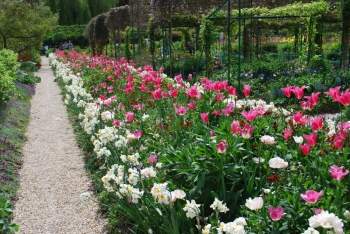 If you are planning a visit to Monet’s garden in Giverny, you may wonder what is the best time of year to come. There are many! The scenery, the flower show change with the seasons. One of my favorite time is the tulip’s.
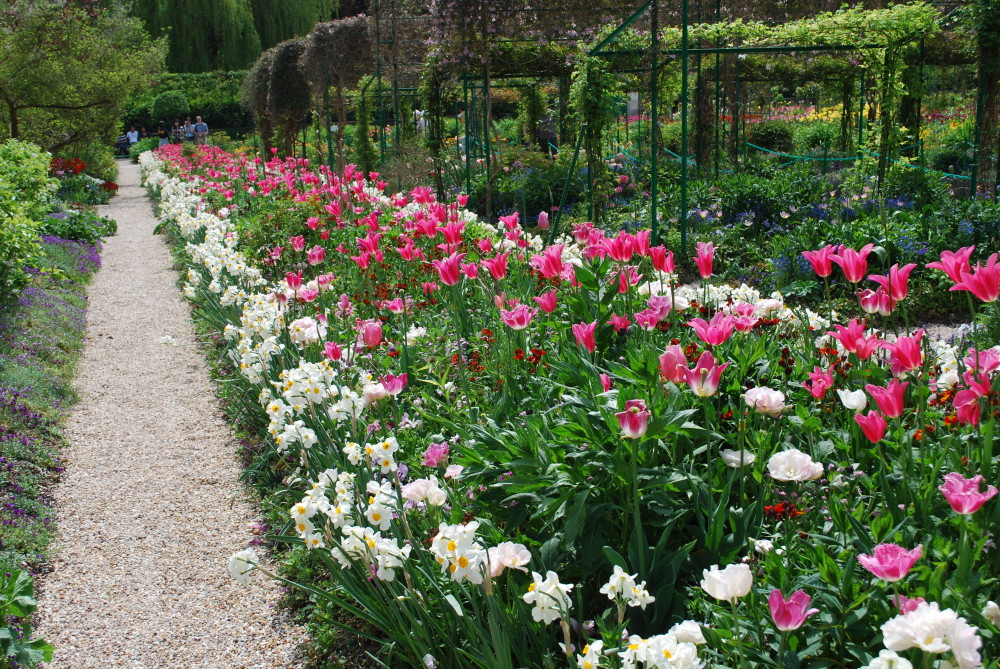
Tulips flower mostly during the second half of April. Their blooming is spectacular, gorgeous, breathtaking. They offer colors, colors, colors, always bright ones, they can have soft and tender or very warm flaming tones. They exist in an infinite variety of forms and aspects. And they provide amazing mass effects.
This border, for instance, was designed by Monet after visiting and painting the tulip fields in Holland. He was impressed by the large colorful stripes of these cultures.
When he came back to Giverny, Monet decided he wanted a very long border in his garden, from top to bottom, planted according to a monochromatic scheme.
This oversized flower bed records to his visual experience in Holland, as far as color and size are concerned. But Monet could not be satisfied with one sort of tulips only. His ‘tulip field’ is a very refined mixed border composed of many different sorts of tulips. They harmonize, their pink is slightly different, producing the subtle variation of tones that one can observe on an impressionist painting. A beautiful example of the way Monet used flowers like brushstrokes.
Posted in Monet's flower garden 1 Comment »